
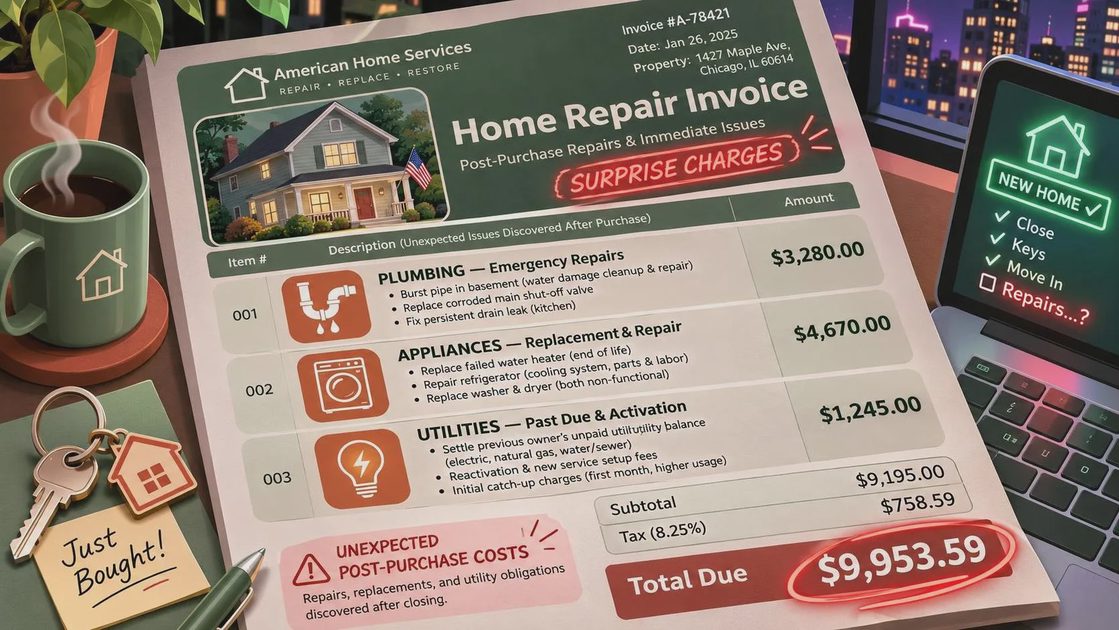
$20,000 can disappear quickly after closing without a single dramatic defect. New home unexpected expenses often include unfinished landscaping, window coverings, insurance, tax adjustments, and repairs the builder does not agree are covered. For a $1 million-plus new build, I would start with a provisional $25,000 reserve for known omissions and ordinary surprises, then add property-specific repair allowances separately. That is a planning figure, not a percentage formula or a substitute for bids.
Start with the expenses you can see
The cleanest money to budget is the money you already know you will spend. Ask for the final specifications and walk the property with them. A beautiful house can still arrive without a refrigerator, garage-door opener, shower enclosure, finished landscaping, or the window coverings shown in the model. What is included varies by contract and property; the model is not your purchase inventory.
For each omission, get an installed price, not just the sticker on the product. Window coverings may need measurements, electrical work for motorized shades, and installation on tall or difficult-to-reach windows. Landscaping may require soil preparation, irrigation, drainage work, and access for equipment. A quote that covers plants but not irrigation is not a complete landscape budget.
On a large house, those two categories alone can run into five figures. The range is wide enough that a local quote is more useful than a national average. Put the amount in your closing spreadsheet now, even if the work can wait.
Also check what happens outside the lot line. Utility connection charges, deposits, mailbox installation, fencing, and community setup fees may or may not be included. Get an itemized list from the builder and the relevant service providers rather than assuming that a certificate of occupancy means every account and amenity is ready.
New home unexpected expenses hiding in the ground
Water management is where a tidy allowance can become an expensive guess. Look at the finished grade, downspout outlets, retaining walls, and the route water would take away from the house. A downspout that empties beside the foundation is a question worth asking, not proof that the foundation has failed.
Photograph low spots and ask whether the drainage system has been completed and tested. If there are buried drains, request their locations, discharge points, and any available installation photos. A landscape bed can conceal the difference between a connected drain and a decorative piece of pipe.
A small drainage adjustment might involve regrading a limited area and extending downspouts. A larger correction could require excavation, hardscape removal, new piping, restoration, and access through a finished yard. Those are different scopes, so do not price the second with the first one's allowance. Get a drainage contractor to inspect the site and provide a written scope; involve an appropriate engineer when the cause or remedy is not clear.
Retaining walls deserve the same treatment. Ask for plans and drainage details where available, and look for movement, cracking, or water collecting behind the wall. A crack alone does not establish a structural problem. The cost question is whether the issue calls for monitoring, a localized repair, or a designed replacement. Those answers have very different dollar signs.
Price the repair all the way back to finished
An inspection report might identify a roof leak, poorly flashed window, or HVAC deficiency. It usually does not tell you the full cost of opening the assembly, finding the source, making the repair, and putting the house back together. On a luxury build, matching stone, custom millwork, specialty paint, and imported tile can make restoration a substantial part of the bill.
Build each allowance in layers: investigation, access and protection, correction, finish restoration, and cleanup. Add a separate contingency for concealed conditions rather than quietly assuming the wall cavity is perfect. If the defect turns out to be smaller, you can release that money later. The reverse is harder on your bank account.

For example, a stained ceiling below a bathroom may need a plumber to locate the leak, a drywall opening, repair of the source, drying if materials are wet, and ceiling refinishing. The stain does not tell you which component failed or how much material must come out. A contractor's site-specific estimate is worth more than a confident number attached to a photograph.
Do not treat a warranty as cash in the bank. Record the issue before closing, ask for the proposed correction and schedule in writing, and verify the work afterward. Coverage, exclusions, and response procedures vary. Until an item is accepted and corrected, keep a separate allowance for work you might have to fund yourself. That is budgeting, not a prediction about a claim.
The carrying costs a purchase price misses
Get an insurance quote for the actual property before closing. Replacement cost, roof characteristics, deductibles, and location can move the premium. Ask specifically about wind, hail, flood, and water-backup coverage where relevant; a standard homeowners policy does not necessarily cover every source of water damage.
Property taxes need their own line. A new house may have been assessed previously as vacant land or as partially completed construction, so a historical bill can understate what the completed property will be assessed for. Ask the local appraisal or assessment office how and when the improvement is valued, then estimate the bill using the applicable local rates. Exemptions and assessment rules vary. An escrow payment can also change when the lender updates its estimate.
Finally, price the recurring work the house actually requires: pool service, irrigation maintenance, HVAC filters and service, pest control, landscaping, and any association charges. A large lot and complicated equipment schedule create ongoing obligations even when nothing breaks.
Turn the unknowns into a usable reserve
Separate your spreadsheet into three buckets: confirmed post-closing purchases, quoted repairs, and unresolved risks. Do not count the same drainage bid in both the repair total and the general contingency. For unresolved items, write down what is unknown, who can investigate it, and when you will have a better number.
The provisional $25,000 reserve is a starting conversation, not a cap. A property with a steep lot, extensive retaining walls, a pool, or unresolved water intrusion may need materially more. A house with documented completed work and fewer omissions may need less. Before you sign, get the highest-consequence unknowns scoped and priced; after closing, keep the reserve liquid until those items are resolved.
The useful question is not whether a new house has a few imperfections. It is which imperfections are cosmetic, which need investigation, and how many dollars it takes to leave each one properly finished.



No letters yet — pray write the first.