
$100,000 is a 10% overrun on a $1 million construction budget. That is a calculation, not a prediction, but it shows why new construction cost overruns deserve a line-by-line review before you commit. Start with the contract price, add every known exclusion and allowance gap, then carry a separate reserve for unresolved risks. A polished kitchen rendering will not pay for a retaining wall nobody priced.
Start with the number you will actually pay
The advertised base price and your total project cost are different animals. A useful budget includes the land if you are buying it, construction, site work, design and engineering fees, permits, utility connections, financing costs, selections, landscaping, and the cash you may need after closing. Some may already be included; others may not. The job is to find out which.
For a finished spec home, the purchase price may cover most construction costs, while the buyer still faces inspection expenses, financing charges, window coverings, landscaping, or repairs the builder does not complete. For a custom build, the buyer may be exposed to many more moving parts. Do not use the same budget checklist blindly for both.
Ask for the detailed estimate, plans, specifications, allowance schedule, and list of exclusions. Put them next to each other. If the drawings show a feature but the estimate does not clearly include it, ask for a written price or confirmation of inclusion. A blank cell is not a zero-dollar commitment.
Allowances make new construction cost overruns look smaller
An allowance is a placeholder, not necessarily the price of the item you will choose. Suppose the budget carries $20,000 for plumbing fixtures, but the documented selections total $30,000. That is a $10,000 gap before any applicable markup, tax, freight, or installation difference. The numbers are illustrative; actual selections and contract terms determine the bill.
Ask whether each allowance covers materials only or also labor, delivery, tax, and installation. A lighting allowance that pays for fixtures but not decorative installation can leave a surprisingly dark spot in the budget. Request a selection schedule with quantities and model numbers, then compare the total with the allowance before ordering.
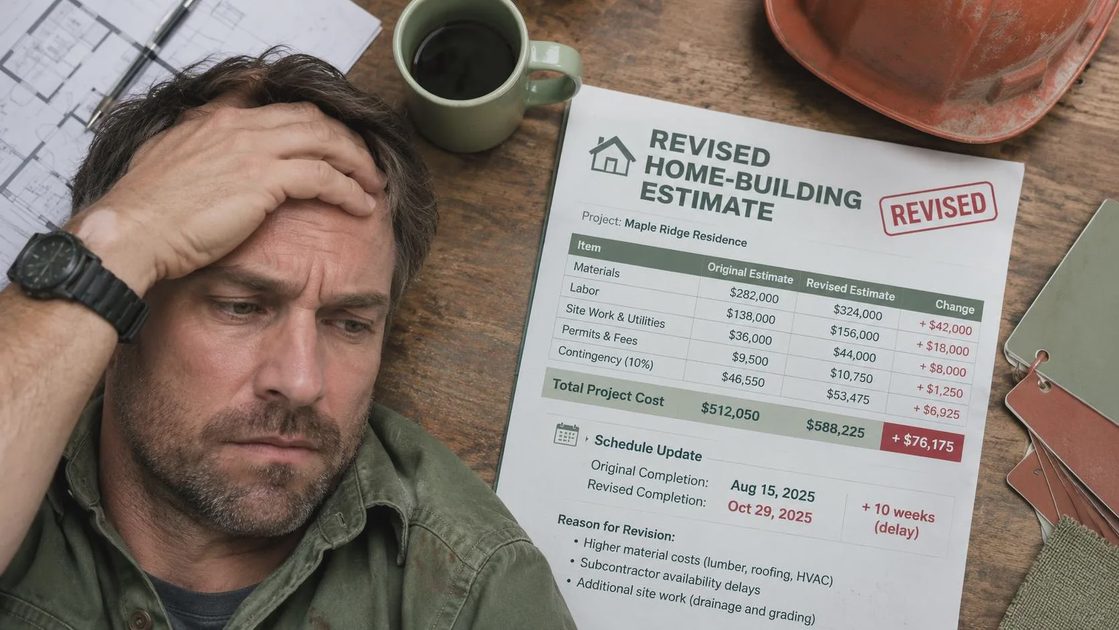
Also look for provisional or estimated site-work amounts. These may be reasonable placeholders when conditions are unknown, but they are not the same thing as a fully developed price. Ask what investigation supports the estimate and what conditions could change it. Get the answer in writing while there is still time to compare alternatives.
Site work is where the ground sends its invoice
Grading, excavation, drainage, rock removal, soil improvement, retaining walls, and utility extensions can sit outside a headline construction number. The cost depends heavily on the lot and the work required; a neat price per square foot will not tell you what is buried beneath a driveway.
Start with the survey, geotechnical report if one exists, grading plan, and utility information. Ask who has verified connection points and whether the estimate includes trenching, backfill, meters, and any required upgrades. On a sloped lot, look for retaining walls on both the drawings and the pricing schedule. A wall drawn in a pretty landscape plan still costs money to engineer and build.
If drainage depends on a swale, drainpipe, or finished grading, ask where that work appears in the scope. Then ask where the water goes. A pipe ending at a property line without an approved discharge route is a question, not a drainage strategy.
For an existing new home, the question changes: was the work actually completed, and does the site move water away from the structure? Have qualified professionals investigate persistent ponding, exposed fill, or water entering the building before treating any repair allowance as adequate.
Changes, delays, and the cost of waiting
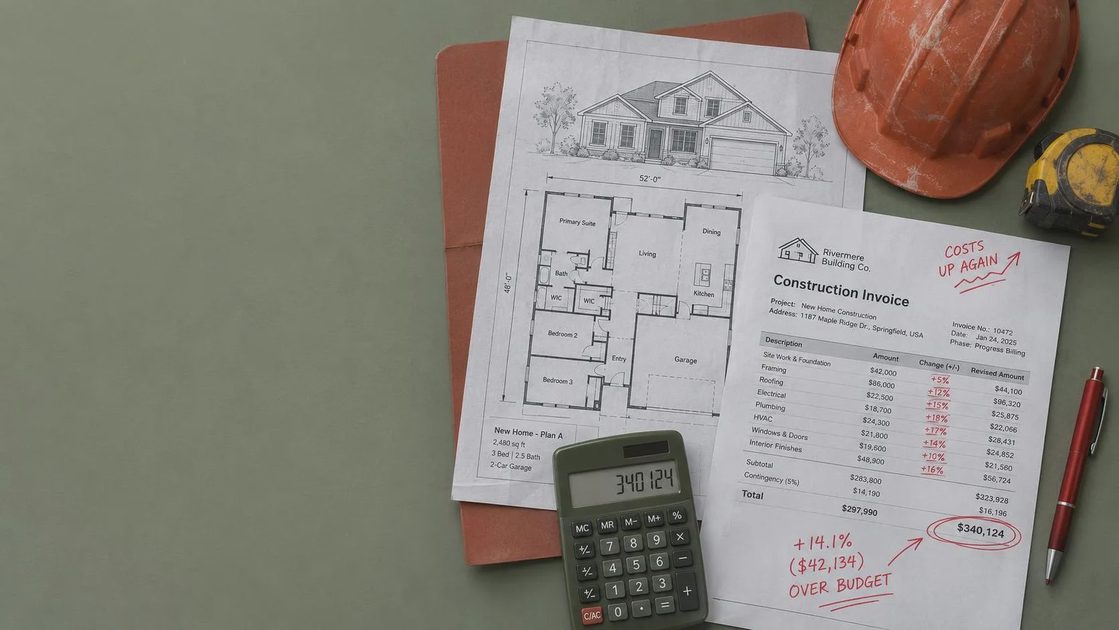
New construction cost overruns do not always arrive as one dramatic excavation bill. A change to tile can also change substrate preparation, labor, trim, and delivery. Moving a window after framing may affect the wall, exterior finish, interior finish, and schedule. Ask for a written change price that separates materials, labor, markup, and any schedule effect before authorizing the work.
Carry time in the budget as well as dollars. A delayed completion can extend temporary housing, storage, insurance, or financing costs. As a simple illustration, an extra two months at $4,000 per month in carrying costs adds $8,000. Use your actual obligations and ask the lender how a delay could affect them.
A promised completion date is useful only alongside an updated schedule and a clear account of outstanding work. Ask which selections, inspections, and utility connections are on the critical path. If the answers are vague, budget time accordingly rather than assuming the calendar will behave.
Separate a construction contingency from a repair reserve
A contingency covers uncertain project costs that may arise before completion. A repair reserve covers defects or incomplete work you may have to address after taking possession. They are related, but combining them makes it easy to spend the repair money on countertop upgrades.
Build each reserve from identifiable risks rather than treating one percentage as universally correct. For example, list an unresolved utility connection, the cost range provided by a qualified contractor, and whether the builder's price already includes it. Then list a separate post-closing item, such as correcting a documented drainage problem, with an independent estimate and any investigation still needed.
Avoid counting the same scope twice. If the builder agrees to complete a repair before closing, track the work and its verification separately; do not simply erase the risk because someone promised to handle it. A reserve is a planning figure, not evidence that the repair will cost exactly that amount.
Audit the closeout before releasing your budget
Before closing or final payment, walk the property with the relevant plans and specifications. Record incomplete work, visible defects, and discrepancies in a dated list. Photograph each item and ask for a written completion plan. For concealed or technical concerns, consider an independent inspector or appropriately qualified specialist; a walkthrough cannot verify every hidden condition.
Request closeout documents relevant to the home, including equipment information, applicable warranties, and available inspection records. Understand the process and deadlines for reporting problems, but do not assume a warranty will cover every condition or pay for every related expense.
The final test for new construction cost overruns is straightforward: can you trace each substantial number to a scope, an assumption, or a written quote? If not, the spreadsheet is telling you what to investigate next. A tidy total is not the same as a complete budget.


No letters yet — pray write the first.