New construction landscaping cost commonly lands between $15,000 and $75,000 for a completed home, and luxury properties can push past $100,000 before the first tree reaches the roofline. The builder's answer, "landscaping allowance included," is not a budget. It is a placeholder with attractive landscaping brochure energy and the financial precision of a napkin at a barbecue.
I have walked plenty of new homes where the interior carried a seven-figure price tag and the exterior consisted of compacted clay, three struggling shrubs, and a sprinkler stub pointing at the driveway. Buyers budget for cabinets, window treatments, and a pool. Then the first rain exposes the missing drainage and the first summer turns the yard brown. Do not ask whether the lot needs landscaping. Ask how many dollars you have to spend before it functions like a finished property.
The Basic Cost Range by Lot Size
For a small urban lot, a practical starting budget is $12,000 to $25,000. That might cover grading touch-ups, topsoil, sod or seed, a modest irrigation system, foundation planting, and basic mulch. It does not usually include a large retaining wall, mature specimen trees, outdoor lighting, or extensive drainage work.
A typical suburban lot with 3,000 to 6,000 square feet of usable yard often requires $25,000 to $55,000. The number rises quickly when the site needs imported soil, a new fence, several zones of irrigation, a patio, and trees large enough to provide immediate shade. A high-end property with steep grades, stonework, privacy screening, or a broad entertaining terrace can reach $60,000 to $125,000.
Those ranges explain why new construction landscaping cost should be treated as a construction line item, not a decorative afterthought. Sarah would put the allowance in a spreadsheet, separate hard costs from soft assumptions, and circle every number that has no supplier quote attached. That is the correct level of suspicion.

Where the Landscaping Money Actually Goes
The visible plants are rarely the largest surprise. Site preparation is often the first expensive layer. Construction traffic compacts the soil, leaves concrete washout, buries scraps, and creates uneven grades around the foundation. A landscaper may charge $2,000 to $8,000 for cleanup, fine grading, soil amendments, and imported topsoil on an ordinary lot. Heavy clay or rocky ground can push that preparation well above $10,000.
Irrigation is another common underestimate. A small system may cost $4,000 to $8,000, while a larger yard with multiple zones, drip lines, rain sensors, backflow protection, and a smart controller can run $10,000 to $20,000. Ask whether the quote includes the water connection, trench restoration, controller programming, and a serviceable shutoff. A sprinkler system that cannot be repaired without excavating the walkway is not a bargain; it is a future invoice.
Plant material varies wildly. Five-gallon shrubs are inexpensive compared with 15-foot trees, but small plants take years to provide screening. A single mature oak, magnolia, or evergreen can cost $1,500 to $5,000 installed, depending on size, access, delivery, staking, and warranty. Multiply that by eight and the decorative border becomes a serious capital purchase.
Drainage Is Not Landscaping Fluff
Here is where new construction landscaping cost gets distorted. Builders often leave the final surface grade for the landscaper, while the landscaper assumes the builder has already solved water movement. Both assumptions can be wrong, and gravity does not care which subcontractor won the argument.
Walk the lot after a hard rain if possible. Look for water collecting beside the foundation, downspouts discharging onto planting beds, soil sloping toward the house, and swales that terminate at a fence. Corrective work can include solid pipe, catch basins, pop-up emitters, channel drains, dry creek beds, regrading, or a retaining structure. Basic drainage improvements may add $3,000 to $10,000. A complicated rear-yard correction with limited access can exceed $20,000.
The phrase "some standing water is normal" deserves a measurement, not a shrug. A shallow puddle that disappears quickly is different from saturated soil against the foundation or a recurring pond beside the garage. Landscaping should direct water away from the building, not camouflage a grading defect with decorative rock.
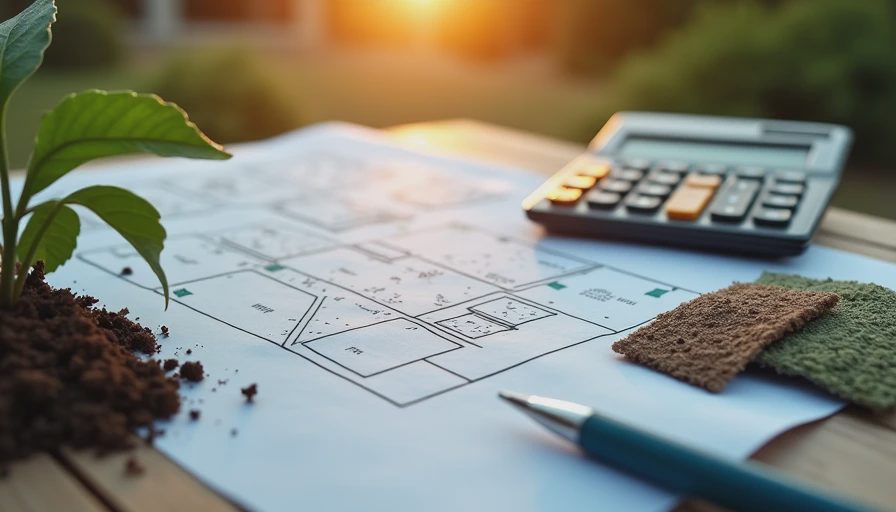
Hardscape Changes the Entire Budget
A buyer who says, "We only want a simple backyard," often means a patio, walkway, seating wall, grill pad, landscape lighting, fence, and a place for the dog. Ranger has taught me that dogs do not recognize a finished yard until every weak irrigation connection has been excavated. The human version is a $30,000 hardscape change order.
Concrete is generally less expensive than natural stone, but access, reinforcement, demolition, drainage, and finish quality matter. A basic concrete patio may cost $5,000 to $12,000. Pavers can run $12,000 to $30,000 or more, while natural stone and detailed masonry can pass $40,000. Add a pergola, outdoor kitchen utilities, a gas line, or low-voltage lighting and the original landscape allowance becomes decorative fiction.
Fencing deserves its own quote. A basic wood fence might cost $4,000 to $12,000 around a standard yard; masonry, steel, composite, or difficult grade conditions can cost considerably more. Verify gates, hinge hardware, demolition, stain, and access for future maintenance. The cheapest bid often excludes the parts that make the fence usable.
How to Audit a Landscaping Proposal
Start by demanding a scaled plan, not a collection of plant photographs. The plan should show finished grades, drainage routes, irrigation zones, plant quantities, mature sizes, hardscape dimensions, lighting, utility conflicts, and warranty terms. If the proposal says "allowance" beside half the scope, you do not have a price. You have an invitation to spend more.
Next, separate one-time construction from recurring maintenance. New construction landscaping cost includes installation, but a sophisticated yard may require $150 to $500 per month for mowing, pruning, fertilization, irrigation adjustments, and seasonal cleanup. A dramatic planting design that needs constant trimming is not automatically superior to a simpler, durable layout.
Finally, obtain at least two bids from firms that perform the same scope. Compare quantities, not just totals. One company may include 20 cubic yards of topsoil and another only five. One may specify 15-gallon trees while another prices five-gallon stock. Those are not equivalent proposals, even if the totals look close.
A Realistic Reserve Before Closing
For a $1 million-plus new home, I would rather see a documented $40,000 landscaping reserve than a vague $10,000 allowance. On a difficult lot, I would set aside $60,000 to $90,000 until grading, drainage, irrigation, and access are verified. That reserve is not permission to overspend; it is protection against discovering that the finished house ends at the back door.
New construction landscaping cost should be based on the yard you intend to use, not the yard shown in the builder's rendering. Price the soil, water, trees, privacy, drainage, hardscape, lighting, and maintenance separately. Then walk the site with the estimate in hand and mark every assumption that depends on another subcontractor's promise.
The house may be new. The exposed dirt is not a minor detail, and the bill will not remain theoretical. Get the number before closing, while the facts still have leverage. As I tell every buyer who shows me a glossy exterior rendering: do not ask if the yard is unfinished. Ask how many dollars stand between this lot and a functioning property.


No letters yet — pray write the first.